BOLDGROUPTHAILAND Back to overview
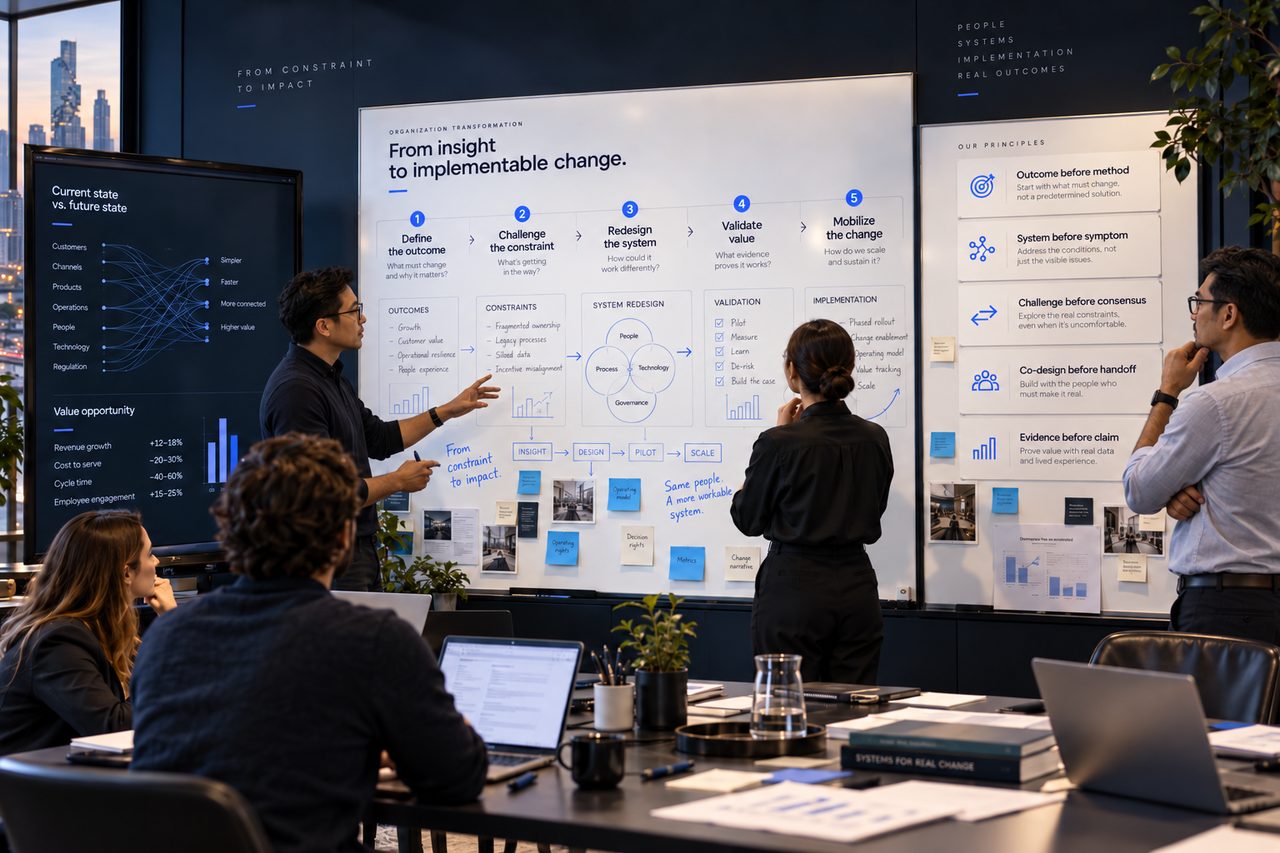
Five people in a meeting room, one standing and gesturing toward a large wall-mounted board while the others look on.
HOW BOLD GROUP WORKSOUTCOME-LED / EVIDENCE-DISCIPLINED
HOW WE WORK

Challenge the constraint. Redesign the system. Make the change workable.

The same five stages run through every engagement. What changes between them is who is accountable for what, and how far the work goes.

SCROLL FOR THE FIVE STAGES
01FIVE STAGES

From the result that must change, to something the organization can act on.

  1. 1

    Define the outcome

    We clarify what must change, why it matters, the baseline, the target, the scope, the executive sponsor, the measurement owner, and the evidence required for a decision.

    Output A shared outcome and decision frame.

    What it settles
    The result this engagement is accountable for, the number it starts from, and the one person who can decide.
    What it does not
    Nothing about the cause. A defined outcome is not a diagnosis, and at this point the constraint is still whatever the organization already believes it to be.
  2. 2

    Challenge the constraint

    We examine the end-to-end system and test the assumptions the organization has treated as fixed. The visible symptom, familiar solution, and actual constraint may be different.

    Output A constraint model and prioritized assumptions.

    What it settles
    Which assumptions the present result actually rests on, and which of those have never been tested rather than never been questioned.
    What it does not
    Whether any of them can be moved. Naming a constraint is not the same as having a design that removes it, and some constraints are real.
  3. 3

    Redesign the system

    We co-design alternatives across processes, roles, decisions, capabilities, governance, incentives, resources, and technology requirements.

    Output Future-state alternatives and a selected design.

    What it settles
    A future state whose parts fit each other — process, roles, decision rights and governance that do not contradict one another.
    What it does not
    Whether it works. The design is complete at the close of this stage, which is not a claim that it produces the result.
  4. 4

    Validate the value

    We test the critical technical, operational, commercial, stakeholder, and implementation assumptions. We define what is known, projected, uncertain, or still requires evidence.

    Output A validated value and risk case.

    What it settles
    What the design is expected to be worth, on assumptions that are written down, with the uncertain parts named as uncertain rather than averaged away.
    What it does not
    Realized value. A projection is what a stated method expects, not what the business later recorded — which is the whole distance between what you project and what you later confirm.
  5. 5

    Mobilize the change

    We translate the selected design into ownership, sequencing, requirements, governance, measures, vendor roles, and capability development.

    Output A blueprint or operating system the organization can act on.

    What it settles
    Who owns each part, in what order, against which measure, with the vendor roles and capability gaps written down rather than assumed.
    What it does not
    The implementation, and the measurement after it. Whoever runs them — the organization, a vendor, or Bold Group under a separate scope — the evidence does not move past this point until they have happened.

The method keeps going where the claims stop: a design at the close of stage three, a projection at the close of stage four, and nothing further claimed until the change has run and someone has measured what it produced. That is not a gap in the record; it is the record. A published case says only what its record supports: that a design was produced, a client team modelled what it should be worth, a client put it into operation, or the client reported a measurement against a baseline. The limit is the record’s, not the method’s. See what each case can show

02SIX OPERATING PRINCIPLES

What we hold to when the work gets uncomfortable.

Outcome before method

The method serves the business result. Bold Group does not sell a favored tool as the answer to every problem.

System before symptom

We examine what keeps producing the present outcome rather than treating the visible problem in isolation.

Challenge before consensus

Agreement is not useful when it protects an incorrect assumption. Bold Group creates productive discomfort so the organization can see alternatives.

Co-design before handoff

The people who understand and will operate the change participate in designing it. This improves practicality and ownership.

Evidence before claim

What we designed, what the client projects, and what the client later confirms remain distinct. Uncertainty is made visible rather than hidden behind confident language.

Capability before dependency

Bold Group's objective is to leave the client able to operate the new system, make decisions, and continue improving without permanent dependence on the consultant.

03METHODS WE DRAW ON

Named methods, and whose they are.

An engagement uses whichever of these the problem needs, and none of them is a substitute for the diagnosis. All of them belong to someone else, so each is stated with its source.

  • Systematic Inventive Thinking

    A structured ideation discipline derived from TRIZ.

    Used at the redesign stage to generate alternatives inside a fixed constraint, rather than waiting for an idea to arrive. It is most useful where a team has already concluded that the obvious answers are exhausted.

  • Strategic foresight

    An established planning discipline, not a proprietary framework. Teerasak has practised it since 2005 and Ralph Rettler since 2007, across client foresight studies.

    Used when the design has to survive conditions that do not exist yet — regulation, supply, technology, or customer behaviour that is moving. It keeps a redesign from being optimised for the present alone.

  • The ISO 56000 series

    International standards for innovation management, published by ISO.

    Used as the reference model when an organization wants its innovation management system to be structured, auditable, and recognisable to an outside assessor. Bold Group applies the standard and does not certify against it.

  • The CIRCO method

    A TU Delft method, built on its Products that Last and Products that Flow frameworks. Teerasak and Suttisak are both certified CIRCO trainers.

    Used for circular business design, where the redesign has to change what a product is made of, how long it lasts, and who owns it at the end of its life — not only how it is produced.

04ACCOUNTABILITY

Accountability changes with the engagement.

Who owns the design, who owns the delivery, and who owns the result are not the same question, and the answer differs by engagement.

Business Transformation & Process Redesign
Bold Group owns design quality and the reasoning that connects the design to the expected improvement. Implementation ownership is defined contractually.
Innovation Management System Implementation
Bold Group establishes and operationalizes the system with the client, then transfers operating responsibility.
Innovation Team Assessment
Bold Group conducts the interviews and produces the team design. What the organization does with it stays with the sponsor.
AI Value Realization
Bold Group owns business and workflow design; technical providers own technical delivery.
Client representation
Within the two flagship engagements, Bold Group protects business requirements and design intent inside the agreed mandate.
05WHAT WE NEED FROM YOU

The conditions that make the work worth doing.

These are not preferences. Where they are absent, the engagement produces a design and not a change, and we would rather say so before it starts than afterwards.

  • an executive sponsor with appropriate authority;
  • access to the people who understand the work end to end;
  • reliable information and willingness to test assumptions;
  • decisions and resources at the agreed moments;
  • internal owners who will carry the change; and
  • openness to an answer different from the solution initially imagined.
06START HERE

Bring us a result worth changing.

Describe the outcome, the constraint as you currently understand it, and who owns the decision.

Discuss the outcome that matters