Walk the line and find where value stops being recoverable
Go through the production line step by step and establish at which step a rejected piece stops being material that can be used again and becomes waste.
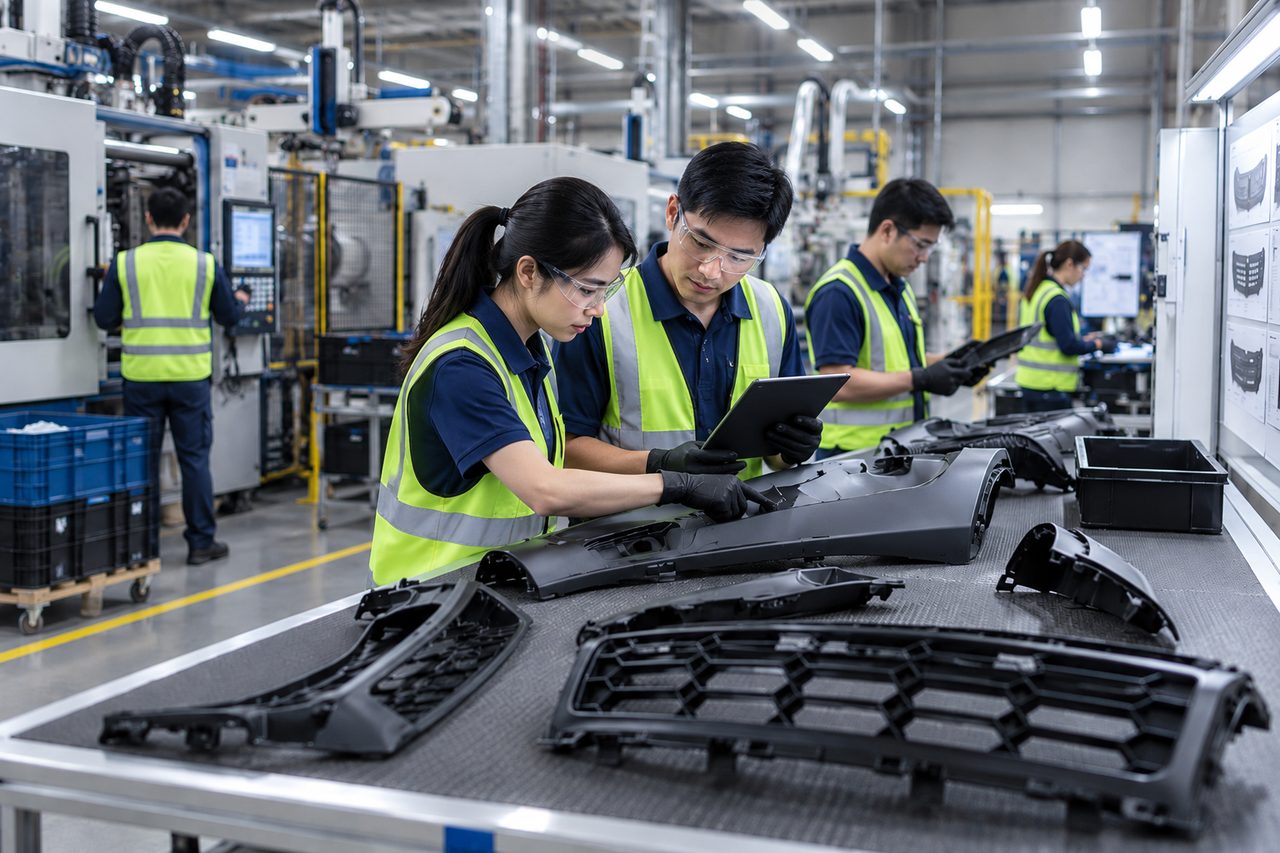
Our client is a factory producing automobile parts by plastic injection.
The plant ran one quality-control station, inspecting finished parts at the end of production before they went to the warehouse. Colouring happens earlier in the line, and it cannot be undone: once the plastic carries its colour it cannot go back into the melt for this part, while the same piece rejected before colouring can be melted and put back in as raw material. What a reject was worth therefore depended on where in the line it was found, and every reject was found at the end. Walking the production line, Bold Group identified that one step as the point of no return and observed that inspection sat past it. The client designed the second inspection, staffed it, and installed it. It required no expensive equipment.
A business constraint, the decision it forced, and what Bold Group contributed to that decision.
The client operated the design and modelled its value. The model is theirs, and no measured saving has been reported back.
The plant ran one quality-control station, inspecting finished parts at the end of production, before they went to the warehouse.
That placement was the plant's normal practice. Colouring happens earlier in the line and cannot be undone: once a piece carries its colour it cannot go back as raw material, so a defect found at the finished end is found after the moment recovery was possible.
At what point on this line does a rejected piece stop being material we can use again, and is anyone looking before then?
The decision the client took was to add an inspection before colouring, at the last point where a rejected piece is still material the line can use again.
Go through the production line step by step and establish at which step a rejected piece stops being material that can be used again and becomes waste.
Colouring cannot be undone. Before it, a rejected piece is plastic that can be melted and returned as raw material; after it, the same piece is waste. That one step divides the line into a part where a mistake is recoverable and a part where it is not.
Inspection was at the end of production, where the product is finished. Every reject was therefore found after the material had already been committed — not because the inspection was poor, but because of where it stood.
Identified the gap between where defects were found and where material could still be recovered. The contribution was the observation.
Designed the second inspection, staffed it, installed it, and operates it. Its accounting department produced the cost model and owns the assumptions in it.
The plant's production waste was worth approximately 150–180 million baht a year before this work. The client's accounting department models a piece caught before colouring as recovering three quarters of what it would otherwise cost as waste. Half of that is the colouring step, which is never performed on a piece rejected before it. A further quarter is the uncoloured piece itself, which can go back into the melt as raw material. Scaled to the year on the department's assumption that effectively all defects appear before colouring, the model gives a 75% reduction in the annual accounting cost of waste. The department's model already carries the cost of running the second station, so the figure is stated after it. The client operates the inspection. No measured saving has been reported back.
01The accounting model above is the client's own, and it is a model. It is not a measured recovery.
02The client operates the inspection. No measured saving has been reported back, and Bold Group did not measure it.
03Physical waste and accounting cost are different measures here.
04Bold Group's contribution was the observation. The design, the staffing, the installation and the operation are the client's.